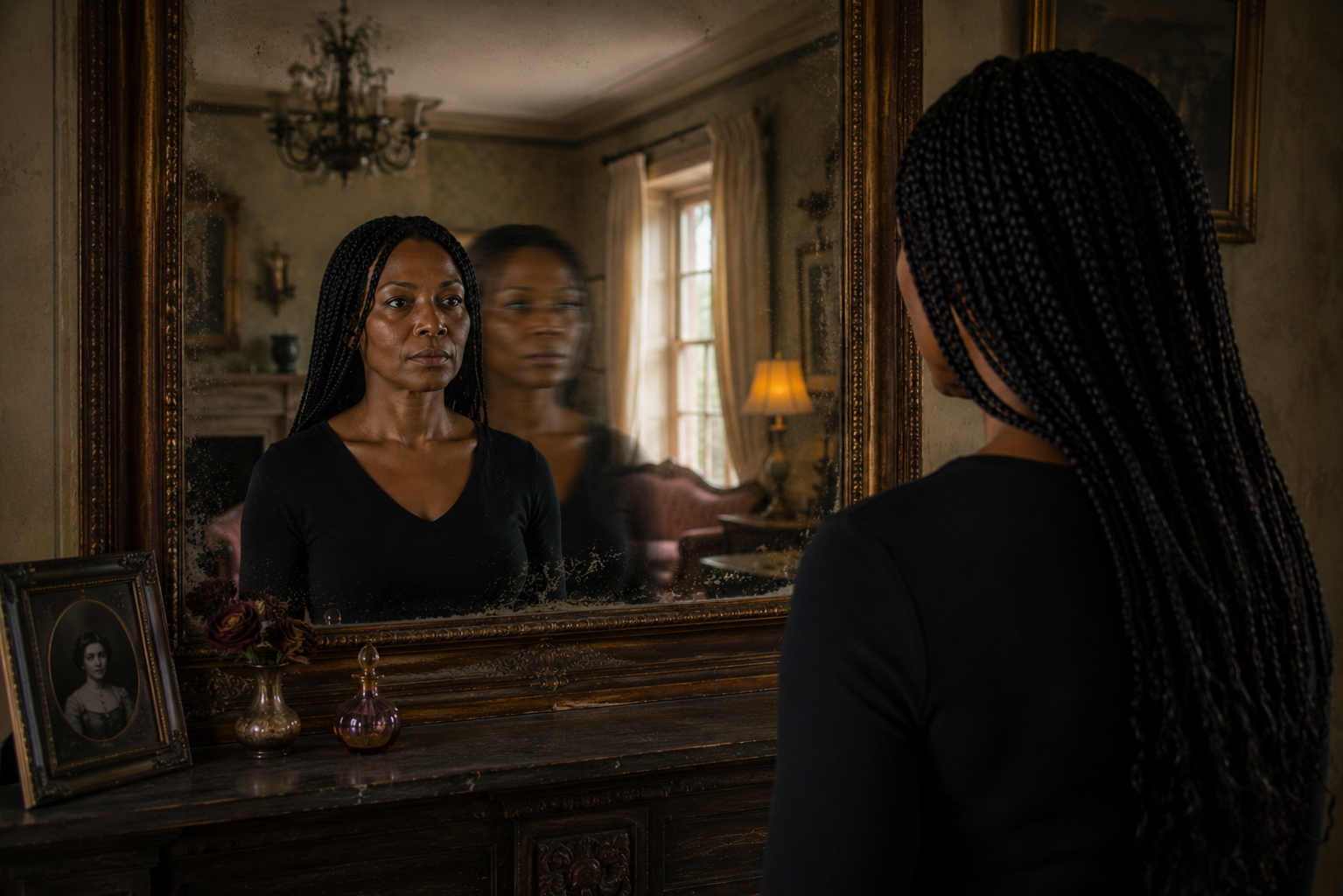
One of the things people may not realize is that Mirror Me wasn’t always the story it is today.
The original version was much more of a science fiction story. It wasn’t really about Charlotte. It wasn’t about the Whittaker family. It wasn’t even about history. At its core, it was simply about a mother trying to understand the different parts of herself that she saw reflected in her children.
That idea has never changed.
I’ve always said that my four daughters are different sides of me. They each carry different parts of my personality, and I wanted to tell a story about what it means to send those pieces of yourself out into the world.
Originally, the house was simply a metaphor for that idea.
Inside the house were different rooms, and each room represented one of the children’s postures. The mother would enter a room and complete a trial before she could retrieve something connected to that child.
I actually wrote some of those scenes.
One room represented Heart. The mother walked into what had become a lagoon. In the middle sat her daughter on a stone, crying. Her tears flowed into the water below, feeding every plant growing around her. The entire room was alive because of her sorrow. The trial wasn’t defeating anything. It was convincing her daughter to step off the stone and come home.
Another room represented Fire. It was a burned-out city where her daughter wandered through the streets setting fires, almost enjoying the destruction around her.
The shrinking room eventually became Shadow, and that idea actually survived into the final version of Mirror Me.
The whole story was strange. It leaned heavily into science fiction and symbolism, and the more I built it, the stranger it became.
Eventually I had to stop and ask myself a simple question.
What story am I actually trying to tell?
That question changed everything.
I realized I wasn’t trying to write about supernatural rooms or elaborate trials. I was trying to write about mothers, daughters, inheritance, and the different emotional postures we pass from one generation to the next.
The message became more important than the mechanics.
That’s when I stopped building scenes and started building lore.
Instead of asking what happened inside the rooms, I started asking bigger questions.
Who are these people?
Why are they here?
How did this family get here?
Where did the stones come from?
Why this house?
Why this land?
Once I started answering those questions, the story transformed.
The objects the mother originally retrieved became the stones of the necklace. The rooms gave way to history. The house stopped being just a metaphor and became a place with generations of memory. The supernatural remained, but now it had a purpose instead of simply existing because it looked interesting.
Looking back, Mirror Me could have stayed on the shelf for a very long time if I hadn’t stopped to rethink what I was really trying to say.
Sometimes the best thing you can do as a storyteller isn’t write the next chapter.
Sometimes it’s stop long enough to ask yourself what story you’re actually trying to tell.
Mirror Me launches February 2027
Leave a Reply