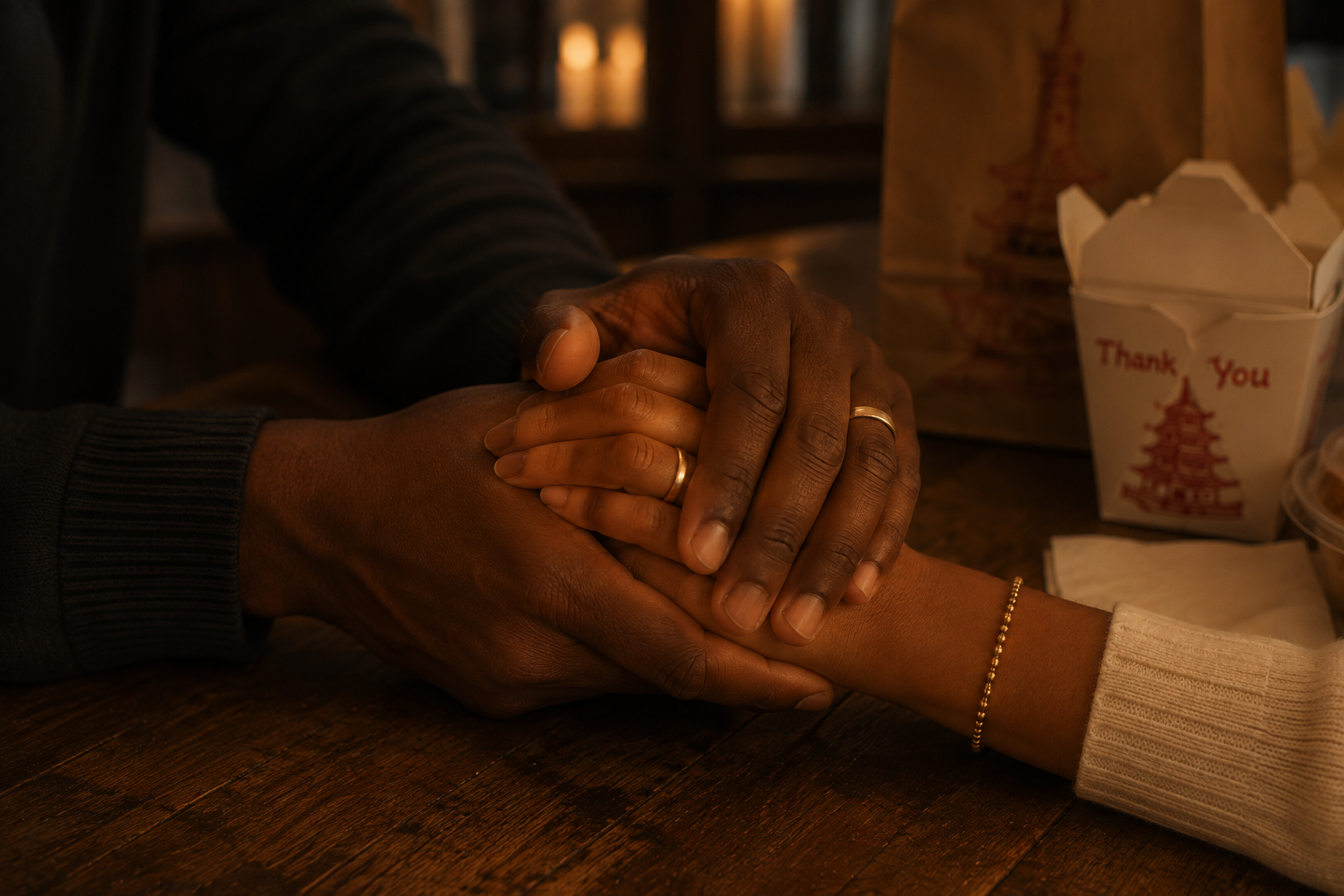
The Husband Who Doesn’t Get in the Way
The first draft of Cedric was a pushover. Every time Sam came to him with something impossible, he said some version of “Okay, I got it.” No pushback, no questions, no friction. I was so focused on writing a supportive husband — one who wouldn’t become an obstacle in an already hard story — that I flattened him into someone who didn’t feel real.
So I rebuilt him. The Cedric in the book now has fear. He has anger, just never at Sam. He disagrees with her. They don’t argue — they have hard conversations that end in a decision, not a fight. He tells her when he’s not happy. And by the end of the book, he protects the house, literally.
There’s a scene at the end of Chapter 11 that’s the clearest window into who he is. Sam is upstairs reading Birdie’s journal, learning that at the vibration site ceremonies, the men never entered the circle — they held the perimeter. Protectors, not participants. She hears Cedric come in downstairs, and it hits her: he’s been doing exactly that. Holding the line around her, securing her, without ever knowing what he was protecting her from. He didn’t need to know. That’s the moment she decides to show him the library.
That scene is where I tied Cedric to the book’s larger architecture — Heart, Fire, Shadow, Wisdom, the postures the women in this family inherit and have to learn to balance. Cedric isn’t holding a stone. He’s holding the ground the stones sit on.
I know some readers will read all this and think no marriage is that easy — that a husband who communicates, doesn’t obstruct, and quietly guards the perimeter without demanding explanation sounds more like a fantasy than a character. And it’s fair to sit with that reaction, because I wrote him partly as a demonstration, not just a description. So many of us walk around dysregulated, in relationships that aren’t balanced, without a clear picture of what balance actually looks like day to day. Sam recognizing Cedric’s protection in Birdie’s journal is the same recognition I want for the reader: the moment you realize someone has been quietly anchoring you, doing the work of showing up without asking what’s wrong, just being the shoulder you rest your head on after a hard day.
If this book does nothing else, I want it to make readers ask: do I have that? Is someone doing that for me — or am I doing it for someone else without being asked?
Leave a Reply